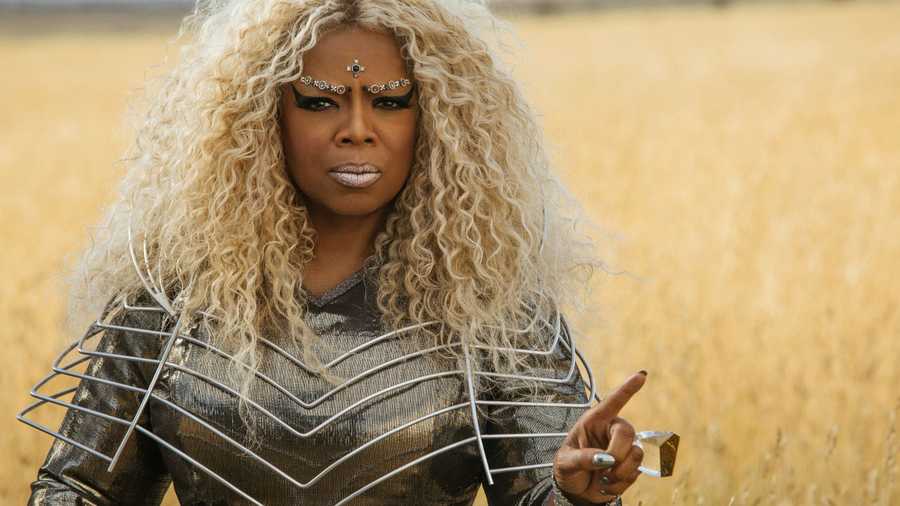
A Wrinkle in Time, the adaptation of Madeleine L’Engle’s 1962 science fiction classic, “directed by Ava DuVernay from a screenplay by Jennifer Lee and Jeff Stockwell, has been a long time coming,” writes A. O. Scott in the New York Times, “and it arrives in theaters buoyed by and burdened with expectations. It is the first $100 million movie directed by an African-American woman, and the diversity of its cast is both a welcome innovation and the declaration of a new norm. This is how movies should look from now on, which is to say how they should have looked all along. Fans of the book and admirers of Ms. DuVernay’s work—I include myself in both groups—can breathe a sigh of relief, and some may also find that their breath has been taken away.”
“By turns gorgeous, propulsive and feverishly overwrought, A Wrinkle in Time is an otherworldly glitter explosion of a movie, the kind of picture that wears its heart on its tie-dyed sleeve,” writes Justin Chang in the Los Angeles Times. “It’s the product of a big, unwieldy and excitingly go-for-broke vision, one etched in bright hues and kaleidoscopic visual effects, in busy musical orchestrations and original pop songs from artists like Sade, Sia and Demi Lovato. Most of all, that vision finds expression in the faces of a diverse ensemble overshadowed, quite literally, by a mega-sized Oprah Winfrey, perfectly if almost redundantly cast as a benevolent deity.”
“There's never been a question as to whether [DuVernay’s] a major filmmaker,” writes Rolling Stone’s David Fear. “Middle of Nowhere (2012) should be taught in film schools on how to make a perfect intimate indie, and Selma (2014) is one of the best biopics made by anybody in the last twenty years, full stop. It was simply whether the barrier-breaking accomplishment would, in the end, outweigh the end-result achievement. This Wrinkle in Time is undoubtedly flawed, wildly uneven and apt to tie itself in narrative knots in a quest to wow you with sheer Technicolor weirdness. It's also undeniably DuVernay's movie as much as Disney's, and works best when she puts her feminine energy, high-flying freak flag and sense of empathy front and center.”
“The film sets up the strong bond between a NASA-employed theoretical physicist, Alex Murry (Chris Pine), and his inquisitive daughter, Meg (Storm Reid), before giving a cursory view of Alex's dreams of traveling light years using only the power of the mind's connection with the universe,” writes Jake Cole for Slant. “Then, the story lurches ahead four years after Alex's sudden disappearance to find Meg floundering in hostility, and the film bogs itself down in repetitive scenes of teenage alienation.”
“Less satisfying than the recent Pete’s Dragon, but told with a similar degree of revisionist zeal,” writes IndieWire’s David Ehrlich, Wrinkle “scrubs away the Christian overtones of the source material in favor of some distinctly twenty-first century humanism. Jesus is out, self-worth is in, and it’s coming for your children . . . It almost doesn’t matter that the movie is too emotionally prescriptive to have any real power, or too high on imagination to leave any room for wonder; DuVernay evinces such faith in who she is and what she’s doing that A Wrinkle in Time remains true to itself even when everything on screen reads false.”
Slate’s Aisha Harris: “Watching A Wrinkle in Time unfold, I had to keep checking myself, wondering if perhaps the reason the film wasn’t working for me was because I’m not its target audience—a young adult. Indeed, the film leans heavily into the perspectives of its youthful protagonists, to the point where at times it feels like it were actually the fantasy of a fourteen-year-old kid. The generically beautiful Calvin is Ansel Elgort lite, and his flirtations with Meg fall flat and feel shoehorned in. Later, the narrative takes a turn into demonic child territory, and Charles Wallace essentially channels an infamous Twilight Zone episode. Depending upon how you feel about demonic children in general, your mileage may vary here, though DuVernay’s camera succeeds in balancing the creepiness (which could prove too much for some small children) with some dark humor.”
“The final act feels like a multi-part miniseries that’s been cut down to a feature film, with a rushed climax that feels too differently paced from the building of the premise and its stakes,” writes Alonso Duralde at TheWrap. “But none of this is a deal-breaker, and the production’s strengths far outweigh its flaws.”
At the A.V. Club, Jesse Hassenger finds that “only Reid and Pine feel like they’re playing fully imagined characters, and DuVernay wrestles with how to make the overstuffed material both contemporary and timeless. For a kids’ picture, A Wrinkle In Time is relatively nuanced and idiosyncratic, with enough honest moments to ground its flights of fancy. Adults may be less impressed by a movie that peers into a pit of adolescent hell before hastily reentering the mystical light.”
“There’s no room to breathe or think or find your own way into an emotional moment,” writes Amy Nicholson for the Guardian. “By the end, I was so smothered in comfort my teeth were grinding.”
“DuVernay can’t seem to settle on a consistent visual or narrative cadence,” finds Vanity Fair’s Richard Lawson. “Her camera is all over the place, hurtling in for woozy close-ups and then rearing back to reveal what is meant to be vast splendor but is often just bland CGI prettiness.”
“There is a part of a filmgoer exhausted by an avalanche of stuff . . . that says, ‘I cannot get on board with a film that delivers wisdom through a giant, glowing Oprah,’” writes NPR’s Linda Holmes. “It’s possible that you have to have been a certain kind of kid to feel the maximum effects of this story. It’s possible that not everyone will experience, as I did, tears arising spontaneously in response not to either sadness or joy, but to truth, to the breaking open of emotional secrets. Tears not jerked, but loosed. . . . There are those who will not get past Sky Oprah. But for those who do, a rich film awaits.”
More from Will Ashton (Playlist, C), Peter Debruge (Variety), Tim Grierson (Screen), Vince Mancini (Uproxx), Peter Martin (ScreenAnarchy), Todd McCarthy (Hollywood Reporter), and Matt Singer (ScreenCrush).
Talking to Melena Ryzik of the New York Times, Ava DuVernay explains why making A Wrinkle in Time took on an unexpected and profoundly personal resonance.
Meantime, Michael Dirda in the Washington Post: “I wish the film well, but having just reread the novel I can understand why editors turned down L’Engle’s manuscript. Artistically, the book is a mess; it’s illogical, derivative and confusing, with a rushed and unconvincing ending. In 200 higgledy-piggledy pages, L’Engle throws together magic, folklore, science fiction, dystopian nightmare, Christian religiosity, 1950s fears about communism, classic notions about individuality and conformity, mystical transcendence, some slapstick humor and a lot of sentimental pablum. One starts to look for the kitchen sink.”
For news and items of interest throughout the day, every day, follow @CriterionDaily.
from The Criterion Current http://ift.tt/2G3QTJp

Nessun commento:
Posta un commento