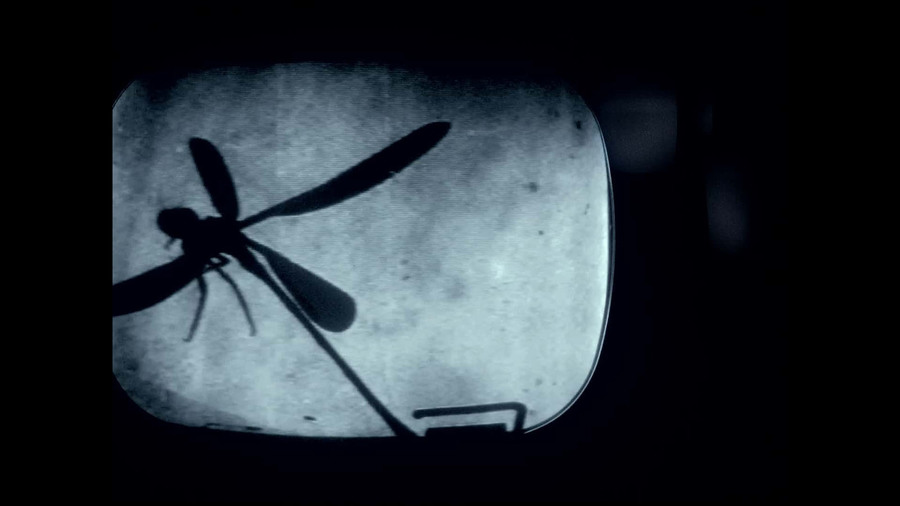
For the seventh year running, the First Look festival at the Museum of the Moving Image in New York presents “formally inventive new works that seek to redefine the art form while engaging in a wide range of subjects and styles.” Links from the titles below will take you to the Museum’s pages and descriptions, so what we’re doing here is adding a little supplementary commentary. First, though, let me recommend three overviews of this year’s edition: Tony Pipolo’s for Artforum, Calum Marsh’s for the Village Voice, and Dustin Chang’s for ScreenAnarchy.
FRIDAY, JANUARY 5
Blake Williams will be at the Museum tonight to present PROTOTYPE (image above), “the film he’s been working toward since his adoption of anaglyph 3D a half-decade ago,” as Jordan Cronk puts it at Reverse Shot. “Far more ambitious than anything he’s yet attempted, the sixty-three-minute film traverses the whole of 21st-century America, serving at once as a meditation on modernization and an excavation of the cinematic apparatus across its many past and present incarnations.”
Andrew Ward sets it up at the Film Stage:
The deadliest hurricane ever to make landfall within the U.S. occurred in-and-around the coastal city of Galveston, Texas in 1900. The storm took roughly 10,000 lives and stripped from the city its title, “The Queen of the Gulf,” which was earned from being the region’s most populous, cosmopolitan, and progressive. During the storm, a mysterious televisual device was built and tested—perhaps mysterious in part because, at the turn of the century, motion-picture photography was only a few years old, and all new devices capable of capturing duration and space must have been originally perceived with an air of skepticism of sorcery. As Blake Williams’s PROTOTYPE opens on historical photographs of a sunny day in early September, 1900, it is perched right on the cusp of pivotal events: of the region’s landscape as the deadly storm soon takes hold, and of the development of cinema as its evolution takes off through the course of the 20th century.
Earlier: Michael Sicinski’s conversation with Williams for Cinema Scope; and for more, see Critics Round Up. The presentation will be preceded by:
- 1207 (2017), a two-minute, subtitled audio presentation by Eleanor McDowall and Radio Atlas, from a radio piece produced by Matthias Hellemans.
- Joe Callander’s No Attempt Was Made to Reattach (2016), also two minutes. Callander “makes what may be described as microprofiles—terse little shorts about mildly interesting people,” writes Marsh. This one’s “about a cabinetmaker who lost the top phalanges of his left index finger in an accident with a table saw in the early Eighties.”
- Daniel Cockburn’s The Argument (with annotations) (2017), twenty minutes. From the Toronto International Film Festival: “What begins as an enquiry on things that mean other things itself becomes a thing that means other things, too. And whatever exactly that thing is, the latest by one of Canada's most ingenious auteurs is another astounding feat of cerebral and cinephilic dexterity.”
SATURDAY, JANUARY 6
Solveig Melkeraaen’s Tongue Cutters (2017). From the Tromsø International Film Festival: “When the Atlantic cod heads for the Northern Norwegian coast to spawn, the children in the fishing village Myre sharpen their knives and get ready for work. . . . Cod season is the backdrop of the story of Ylva (9) and Tobias (10). Ylva lives in Oslo and comes to visit her grandparents—and to learn cod tongue cutting. Tobias has worked on the docks since he was six and is already skilled with the knife. Now he is to tutor Ylva.”
Daniel Cockburn will present All the Mistakes I've Made (Part 2) (2015), “a live multimedia presentation,” notes Marsh, “part scholarly monologue, part real-time essay film, and part solo theater, a bit like Spalding Gray with PowerPoint. All the Mistakes I’ve Made (Part 2) is about the cinema, and it is smart and amusing. Better still is its curt punch line, provided by none other than Paul Schrader—a sight gag worth the price of admission.”
Raed Andoni’s Ghost Hunting (2017) “which won a special prize at the 2017 Berlinale, is a relatively cool and sober restaging of interrogations and tortures suffered by prisoners in the Israeli interrogation center Moskobiya,” writes Ela Bittencourt for Reverse Shot. “The ethical questions that [Jay] Weissberg raises [in Variety] about documentary filmmakers addressing trauma in this way is not new—it was widely discussed when Joshua Oppenheimer’s The Act of Killing premiered in 2012 . . . But as Ghost Hunting demonstrates, the transformation of a victim or a powerless bystander into a storyteller is one of the most meaningful gestures that cinema has to offer trauma survivors.” More from Stephen Dalton (Hollywood Reporter) and David D’Arcy (Screen).
Anna Zamecka will present Communion (2016), “an affecting portrait of the Kaczanowskis, a working-class family whose daughter Ola, age fourteen, is burdened not only with filling in for an absent, depressed mother, but with helping her autistic brother Nikodem learn the catechism in preparation for his First Communion, while negotiating with her father to eke out a private life,” writes Pipolo. “Given the natural rapport between sister and brother, it’s no surprise the film has won many awards for best documentary.” For Chang, this is “a heart-breaking, beautiful film.”
First Sight: Award-winning shorts from the Jonathan B. Murray Center for Documentary Journalism at the Missouri School of Journalism. All four directors will be there. Again, you’ll find descriptions at the Museum’s site. Here are links to a bit more:
Mouly Surya’s Marlina the Murderer in Four Acts (2017). Critics Round Up. “Sprawling, picturesque vistas of an Indonesian Island lensed in widescreen format as a back drop,” notes Chang, adding that it’s “a rape revenge western from a female perspective” and a “mixture of Bring Me the Head of Alfredo Garcia and Thelma and Louise.”
SUNDAY, JANUARY 7
Teresa Villaverde’s Colo (2017) “plunges straight into the heart of Portuguese austerity,” writes Michael Sicinski for Reverse Shot. It’s “a film that is itself austere, displaying the death of imagination, the collapse of options, and the eventual implosion of identity itself. In Colo, three relatively ordinary people, a teenage girl and her two parents, are struggling to make ends meet. But by the end of the film, they are entirely new, having been shattered by trauma and reassembled into damaged, isolated individuals. This, Villaverde tells us, is the psychological toll taken by objective economic and social change.”
“If I find Syrian filmmaker Ziad Kalthoum’s Taste of Cement [2017] the gem of the lot, it is because it uses every resource of the cinema,” writes Pipolo. “An intimate memoir as well as a moving social document, it is also a work of great audiovisual power and lyricism. We watch the daily routine of Syrian construction workers commandeered to rebuild Beirut from bombed-out ruins, as a voiceover recalls the boyhood memories of the filmmaker whose father was among them.” Followed by live video discussion with cinematographer Talal Khoury.
A double bill of films running about an hour each: Hendrick Dusollier’s Last Days in Shibati (2017) and Sebastien Lifshitz’s The Lives of Therese (2016). Dusollier, who’ll be there, “spends a year in the last old district in Chong Qing one of the mega cities situated in the southern China,” writes Chang. “He films its inhabitants as the neighborhood slowly but surely disappears.” And Lifshits “shifts his gears toward an old pioneer of LGBT movement in a solemn, unsentimental fashion . . . from his usual beautiful young gay subjects in glitzy style. Thérèse Clerc was one of Lifshits’s subjects in his documentary The Invisible Ones (2012) where he chronicled LGBT pioneers. As Clerc is dying of an old age, they mutually decided to record her final moments.”
A special event for Museum members and invited guests will be a conversation between Stephanie Wang-Breal and Tabitha Jackson, director of the Sundance Institute Documentary Film Program, about the former’s work-in-progress, Blowin’ Up, which “takes us inside the walls of an experimental courtroom in Queens, New York, that attempts to redress the way women and young girls arrested for prostitution are shuffled through the criminal justice system.”
Daniela Thomas’s Vazante (2017) is set in Brazil in 1821, shortly before independence. From the Berlinale: “After making several films together with Walter Salles, Daniela Thomas explores in her first solo work transitional race and gender relations sixty years before the end of slavery. Shot in impressively composed, atmospheric black-and-white images, she abandons the nostalgia of exotic colonial myths and concentrates instead on her charismatic actors, whose performances shine a light on their own ancestors’ story: the black slaves, white masters and members of the indigenous population that form their country’s identity.”
FRIDAY, JANUARY 12
Pierre Creton’s Va, Toto! (2017). From FIDMarseille, whose director, Jean-Pierre Rehm, will introduce the film: “Toto is a young wild boar who has just found a home at Madeleine's. . . . Vincent is especially fond of monkeys whose antics he'll go and see all the way to India. And poor Joseph is having nightmares caused by the artificial breathing machine he is forced to use. Pierre is the one who ends up tying all of these adventures together.” After the screening, there’ll be a talk with Creton and his subject, Vincent Barre.
Radio Atlas: Intimacy and Distance, a program of four pieces with Eleanor McDowall and Sayre Quevedo in attendance: The Last Act (2016), Wait (2017), 1207 (2017), and Man in Beer Cafe (1974).
SATURDAY, JANUARY 13
Ken Jacobs will be on hand to present free screenings of four new short works, New York City portraits Shelley Duvall Is Olive Oyl (2017), which the Museum describes as “a series of colorful GIF-like animations of NY street life”; Get Up and Go (2017), “a James Joyce–inspired expansion of a moment in Chinatown, as a woman rises from a bench”; A Spin Through Night City, “a dazzling collection of nocturnal images”; and Along the Elevated (2017), “a dynamic study of city architecture in which Jacobs’s camera follows a speedy lunch wagon.” These are all world premieres, by the way. “In the new work,” writes Pipolo, “Jacobs freezes the present, not in static images but through his own brand of push-me/pull-me seizures, amplifying an object’s organic surge in space while retarding its progress to the next moment in time.”
Marie Voignier’s Tinselwood (2017), “shot in and around the village of Moulandou in the Republic of Congo,” as Pipolo notes. “No narration shapes what we see: a series of distinct, seemingly unrelated activities performed by the inhabitants—trappers, loggers, sand miners, cacao planters, gold prospectors, shopkeepers, and sorcerers—forming a mosaic of a community, which, despite its apparent isolation, is sitting on yet-to-be-exploited resources of gold and diamonds. The camera’s patient focus on physical activity has a vibrancy that no amount of expository dialogue or narration could match.” And Voignier will be there.
Marcelo Novais Teles will also be there to present The Exiled (2017). “Teles, a young Brazilian man, moves to Paris to pursue an acting career in the 80s documents his life in grainy Super-8, Hi-8 and DV,” writes Chang. “L’Exilé is at once a deeply personal film and a time capsule of a certain generation of French filmmakers/actors.”
Pawel Lozinski will be on hand for You Have No Idea How Much I Love You (2016), which “traces a number of therapy sessions in which a mother and daughter struggle to improve their ability to communicate,” writes Pipolo. “But while a ‘real’ professor guides the progress of the women, the latter are played by actresses who, far from enacting a preexistent case study, free associate, using their own life experiences. The result is riveting from start to finish.”
Charlie Lyne will present Missing Episode (2017) and other episodes. Lyne is “Britain’s funniest documentary filmmaker, a virtuoso of unorthodox features and shorts, an invaluable benefactor of cinematic joy,” writes Marsh. “Lyne’s simple comedies have produced, inexplicably, some of the strongest emotional reactions I have had to motion pictures in my life, which I admit is a strange response indeed to what amounts to merely lighthearted nonfiction.”
Alexandre Koberidze will present Let the Summer Never Come Again (2017). Pip Chodorov and Ruth Anderwald discuss the film with Dennis Vetter of Berlin’s Critics’ Week at the Notebook.
SUNDAY, JANUARY 14
James Benning will be there to present three new works, L. Cohen (2012), measuring change (2016), and Readers (2017). “You won’t find a quieter, more contemplative work” than Readers,” writes Pipolo. It’s “composed of five long takes of people facing, though seemingly unengaged with, the camera, each sitting more or less in one position for nearly thirty minutes and reading a book. Like most of Benning’s work, the reverie of the viewer is as much a component as what’s on the screen. . . . Benning’s other two movies—the simply conceived, beautifully shot, aptly titled measuring change and the no less striking L. Cohen—are altogether different. . . . Watching the singular image of Spiral Jetty—the object of Benning’s camera in measuring change, filmed on December 28, 2015 at 8:57 AM and 3:12 PM—is another occasion on which one can muse on the ultimate Benning movie—in which a camera or some comparable recording machine of the future is left running until the end of human history. . . . Beautiful and sobering, measuring change is a meditative masterwork.” L. Cohen, filmed in Oregon, naturally features a song by Leonard Cohen.
Matjaž Ivanišin’s Playing Men (2017) is “a documentary essay about the relationships among Mediterranean men and their games,” notes the Sarajevo Film Festival. “The film takes the form of a travelogue across Croatia, Italy, Slovenia and Turkey, and examines men, young and old, who come together like their ancestors did—to play games. During filming, however, the director suddenly faces a serious creative crisis and turns the camera on himself, turning the film into a playful homage to absurdity.” Preceded by two short films by Joe Callander, No Attempt Was Made to Reattach and The God of 400 People on Drugs, or The Autobiography of Joe Callander*.
Sompot Chidgasornpongse’s Railway Sleepers (2016). Critics Round Up. “Part love letter to the Thai railway system, part documentary, part experimental, this Apichatpong Weerasethakul produced film moves along from Northern Thailand to South, recording two days and two nights of locomotive travel,” writes Chang. “We see travelers of all ages and social strata, eating, talking, gazing and sleeping in a confined biosphere, a great microcosm of the world as it were.”
ROOM H.264: Astoria, NY, January 2018. Directors Jeff Reichert, Damon Smith, and MoMI programmer Eric Hynes will shoot, edit, and screen “an open-ended homage to Wim Wenders’s documentary Room 666” during the course of First Look 2018. “As in Wenders's original, visiting filmmakers, alone with a camera in a hotel room, will answer the question ‘Is cinema a dead language, an art which is already in the process of decline?’”
MONDAY, JANUARY 15
There’ll be another presentation of those shorts from the Jonathan B. Murray Center for Documentary Journalism at the Missouri School of Journalism.
Plus, Sending Out an SOS: First Look Shorts: Talal Khoury’s Mediterranean (2017), Kellan Hayley Marvin’s Welcome to Normal, Joe Callander’s No Attempt Was Made to Reattach and The God of 400 People on Drugs, or The Autobiography of Joe Callander*, Daniel Cockburn’s The Argument (with annotations), and Charlie Lyne’s Missing Episode.
As more reviews come in during the festival, we’ll be making note of them here.
For news and items of interest throughout the day, every day, follow @CriterionDaily.
from The Criterion Current https://www.criterion.com/current/posts/5248-the-daily-first-look-2018

Nessun commento:
Posta un commento