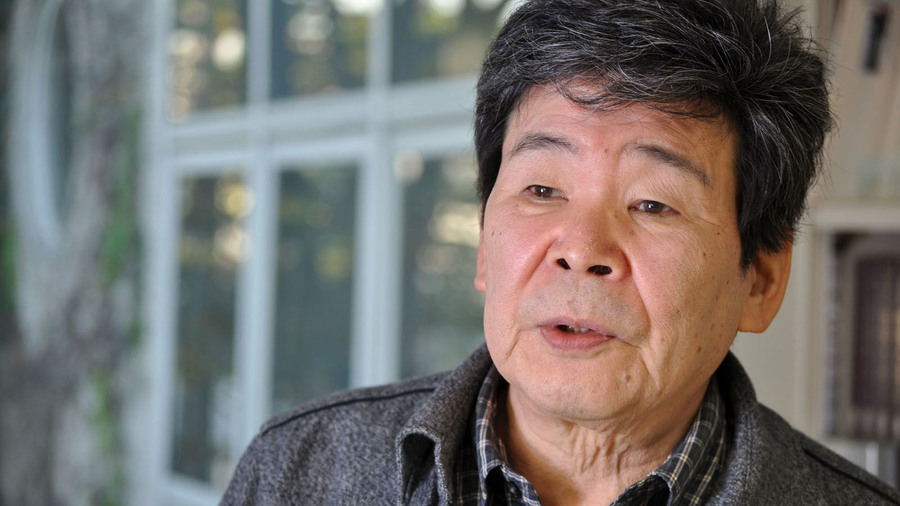
“Isao Takahata, who co-founded Studio Ghibli with Hayao Miyazaki in 1985, has died at eighty-two, according to Yahoo! Japan.” Michael Nordine for IndieWire: “Takahata was a revered director in his own right, helming such animated classics as Grave of the Fireflies [1988], Only Yesterday [1991], and Pom Poko [1994]; he most recently directed The Tale of the Princess Kaguya [2013], which received near-universal praise an Academy Award nomination for Best Animated Feature.”
“Though you’d be hard-pressed to get him to admit it, Japanese animator Isao Takahata is one of the most influential artists in the medium, alongside his longtime collaborator and Studio Ghibli co-founder Hayao Miyazaki,” wrote Terry Flores at the top of an interview for Variety in 2016. “Because Hayao Miyazaki’s various films were so alluring,” Takahata told Flores, “I thought I would realize in my animation films a different appeal and a different expression from what was in his works. In that regard, I suppose you could say I have been greatly influenced by his work. We also share our attitudes toward our love for the nature immediately around us and our political beliefs of anti-nuclear weaponry and anti-nuclear power.”
“Life in Japan was in tune with nature until the modern age,” Takahata told Matt Kamen in Wired in 2015. “A sustainable system was in place for people to receive the fruits of nature while they worked to allow nature to survive in a viable way. All life on Earth is cyclical—birth, growth, death, and revival . . . I consider this to be the basis for everything.”
“It comes as little surprise that Isao Takahata’s Grave of the Fireflies remains as vital and potent as it was nearly a quarter of a century after its premiere in Japan,” Chris Cabin wrote for Slant in 2012. “This wrenching yet largely unsentimental anime depicts the “collateral damage” of the United States’ firebombing of Japan in the waning years of World War II, but its ultimate aim is a universal understanding of the often unreported toll of warfare.” And in 2000, Roger Ebert wrote: “Grave of the Fireflies is an emotional experience so powerful that it forces a rethinking of animation.”
“The protagonist of Only Yesterday is Taeko, a twentysomething career office-worker in modern (well, 1991) Tokyo, who takes a holiday to visit the countryside of her youth, which in turn triggers long-buried memories of Taeko’s turbulent teenage years,” wrote Marc Savlov in the Austin Chronicle in 2016. “As in most other films from Studio Ghibli, there’s a none-too-subtle relationship between the human characters and the natural world outside of the towering Tokyo cityscape. And, of course, there’s also Studio Ghibli’s other recurring theme: that of a strong female character confronting (and usually overcoming) societal obstacles—in this case, the dull toil of the big-city office slog versus all that should have been and may yet well be.”
“For all its goodhearted cheer,” wrote Tasha Robinson at the A.V. Club in 2005, “Pom Poko is a glum indictment of modern Japan's disjunction from the natural and spiritual world. But it strikes a positive final note by implying that those worlds still exist, just out of sight, waiting and flourishing.”
“The Tale of the Princess Kaguya is both very simple and head-spinningly confounding, a thing of endless visual beauty that seems to partake in a kind of pictorial minimalism but finds staggering possibilities for beautiful variation within its ineluctable modality,” wrote Glenn Kenny at RogerEbert.com in 2014. “It’s a true work of art.”
For news and items of interest throughout the day, every day, follow @CriterionDaily.
from The Criterion Current https://ift.tt/2q81c7C

Nessun commento:
Posta un commento