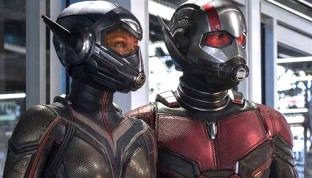
Anche se lo vedremo apparire in Avengers: Infinity War, al 25 aprile al cinema, il ritorno da protagonista di Ant Man nei cinema italiani è previsto tra 7 mesi, nel mese di agosto 2018. Ma già da oggi è posibile vedere le prime immagini del nuovo cinecomic con Paul Rudd nei panni del più piccolo dei supereoi Marvel.
Ecco, infatti, il primissimo trailer in italiano di Ant-Man and The Wasp.
Il sequel diretto nuovamente da Peyton Reed, vede tra i suoi altri protagonisti Michael Douglas (che ritorna nei panni del Dr. Hank Pym), Evangeline Lilly, in quelli di The Wasp, Michelle Pfeiffer, Walton Goggins, Judy Greer, Michael Peña e Laurence Fishburne.
Ecco la trama ufficiale del film:
Dall'universo cinematografico Marvel arriva Ant-Man and The Wasp, nuovo capitolo con protagonista l'eroe con la sorprendente capacità di rimpicciolirsi. Dopo le vicende di Captain America: Civil War, Scott Lang (Paul Rudd) deve affrontare le conseguenze della sua scelta di essere un supereroe ma anche un padre. Mentre si dà da fare per conciliare la sua vita famigliare con le sue responsabilità da Ant Man, deve confrontarsi con Hope van Dyne (Evangeline Lilly) e Dr. Hank Pym (Michael Douglas) su una nuova missione della massima urgenza. Scott deve indossare nuovamente la sua tuta, imparare a volare con The Wasp e insieme scoprire un segreto del loro passato.
Ecco il teaser trailer del film anche nella sua versione originale:
from ComingSoon.it - Le notizie sui film e le star http://ift.tt/2rMXiVI
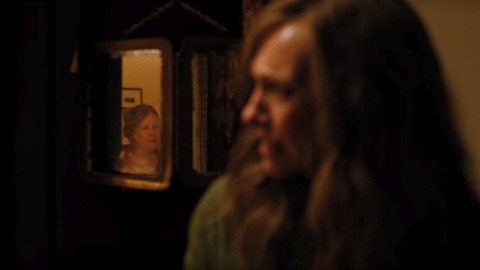
Si chiama Hereditary ed è un film horror diretto da Ari Aster che è stato presentato al Sundance che si è concluso da pochi giorni. Esattamente come avvenuto tre anni fa con The Witch, anche quello prodotto dalla A24, se ne parla come di un capolavoro del genere, di un horror che segnerà un'epoca e farà scuola.
Interpretato da Toni Collette, Alex Wolff, Milly Shapiro, Ann Dowd e Gabriel Byrne, Hereditary racconta la storia di una donna che, con la sua famiglia, inizia a scoprire terrificanti segreti riguardanti la sua famigli dopo la morte della madre. Quelli della A24 hanno deciso di diffondere in fretta un trailer che, secondo noi, fa sperare assai bene per tutto il film. Reggetevi forte.
from ComingSoon.it - Le notizie sui film e le star http://ift.tt/2Gwr5W6
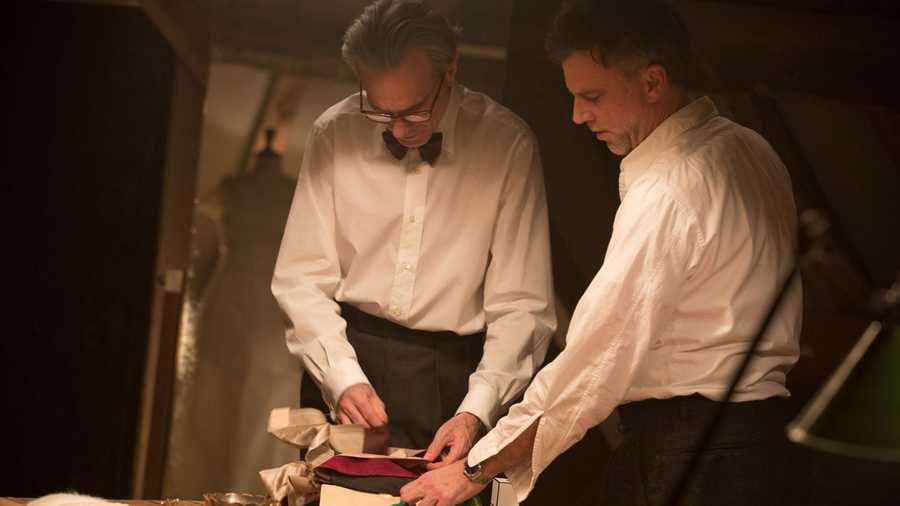
With Phantom Thread opening in the UK on Friday, Screen’s Andreas Wiseman gets Daniel Day-Lewis talking about working with Paul Thomas Anderson. “There’s nothing mad you can do that he won’t encourage you to be madder. I love that. You are always so close to the line of chaos, which you have to be for it to be alive. There’s so much misunderstanding about preparation. You prepare for a long time, of course, if you are lucky, but the only reason you prepare is so that you don’t have a clue what you’re doing when you start, and to have the confidence not to have a clue what’s going to happen. I think Paul loves that element of risk.”
Talking to Anderson for Little White Lies,Adam Woodward brings up Day-Lewis’s retirement. “My take is just to embrace whatever it is he feels he needs to do,” says Anderson, “but I’d be lying if I said I didn’t secretly have something in the back of my mind hoping that we’ll do something else together.” As for himself, “I fucking love doing this. I can’t see myself losing that love. I feel so fulfilled by it. There’s only two places I want to be and that’s with my family or making a movie.”
Earlier this month, Anderson went on “an online publicity tour, dropping into Reddit for an AMA” and “fielding Twitter questions under the #AskPTA hashtag, and generally giving ordinary moviegoers a chance to ask one of the most obsessively studied American filmmakers of his generation whatever they want,” wrote Ignatiy Vishnevetsky at the A.V. Club, noting that “there are some minor insights scattered throughout Anderson’s terse, good-sport answers, from his favorite characters in his own films (Magnolia’s Claudia Wilson Gator and Jim Kurring, Punch-Drunk Love’s Barry Egan, The Master’s Freddie Quell and Peggy Dodd) to his preferred lenses for close-ups (between 50 mm and 85 mm with spherical lenses, either a 75 mm or a 100 mm with anamorphics) to his memories of the young David Foster Wallace, who was Anderson’s English professor before he found fame as a writer. (‘He looked at us like we were all failing him . . . sweetly.’).”
MORE INTERVIEWS
The Guardian’s launched a new podcast, The Start, in which artists discuss their beginnings. The first guest is Sofia Coppola, who talks about her debut feature, The Virgin Suicides (1999): “I remember my Dad telling me that your movie’s never as good as the dailies—everything shot that day—and never as terrible as the first rough cut. When I saw the first rough cut, I thought: ‘Oh no, this is terrible, what have I done? I’ve talked all these people into letting me make a movie and it’s terrible.’ Then, little by little, we pieced it together and made it into a film.”
Earlier this month, John Boorman turned eighty-five, and for Little White Lies,Matt Thrift talks with him about working with Lee Marvin on Point Blank (1967), with Toshiro Mifune on Hell in the Pacific (1968), and with Marcello Mastroianni on Leo the Last (1970), about making Deliverance (1972), his friendship with Stanley Kubrick (“He was so cut off”), and about why Excalibur (1981) resonates with him so deeply and personally.
“This year, two of the finest performances by women were not recognized in many of the awards shows at all,” Meryl Streep tells Tribeca’s Matthew Eng, “and either of them merited walking away with every prize out there: Annette Bening in Film Stars Don't Die in Liverpool and Cynthia Nixon in A Quiet Passion. Incomparable performances, right up there with the ones that are winning everything. Sometimes momentum trumps everything, and life and show business are never entirely fair.”
Quincy Jones’s life has been “punctuated by so many disparate encounters and achievements and circumstances that it is hard to believe they are the experiences of a single man,” writes Chris Heath at the top of his interview for GQ. “There is a lot of talking to do. . . . He tells me about all the celebrations planned for his eighty-fifth year: a Netflix documentary, a prospective ten-part TV biopic he hopes will star Donald Glover, a star-studded TV event on CBS that he tells me Oprah will host.” But first, a look back. To breakfasts with Miles Davis, Frank Sinatra’s pasta, downthumbing Spielberg’s first prototype for E.T., dinners with Elon Musk, and that’s before the conversation turns to music.
“I love South Park,” legendary producer Norman Lear tells Vulture’s Matt Zoller Seitz, who, hearing this from “one of the most important sitcom creators in TV history,” seems a bit surprised: “Those guys are kind of libertarian anarchists with some reactionary tendencies,” says Seitz. “Politically, it’s diametrically opposed to what you believe.” Lear: “It’s doing what All in the Family did in the sense that it’s letting characters express these inappropriate thoughts that people can then argue about.”
Maureen Ryan introduces a roundtable for Variety: “On a sunny day in Beverly Hills almost exactly a decade after the show’s debut, Breaking Bad creator Vince Gilligan met up with Peter Gould, Thomas Schnauz, Moira Walley-Beckett, Sam Catlin, George Mastras and Gennifer Hutchison, the core team of writers who cooked up the saga of Walt, Jesse and their memorable friends, families and criminal associates. During an hour-long conversation, they shared memories of the show’s early days, its characters’ intense journeys and how it all came together in that spectacular final season.” And the conversation’s laced with video clips.
“I remember reading this classic phrase, ‘after all, the human brain is just a computer made of meat,’” Don Hertzfeldt tells Sonia Shechet Epstein at Sloan Science & Film, “and whether or not that’s even remotely accurate, it’s spooky and interesting enough to have really stuck with me over the years. So much of World of Tomorrow is that one little weird theory, and a few others, taken to really over-the-top places. Non-fiction is usually where I find the best little threads of inspiration like that–you don’t need very much.”
Directed by Paul Thomas Anderson
Charlotte Rampling tells Screen’s Geoffrey Macnab that her experiences working with Luchino Visconti and Woody Allen were quite positive—and that she’s still proud of her work on Liliana Cavani’s The Night Porter (1974), a film of “great beauty” and a “tortured, strange, decadent love story.”
“When I was younger, I’d made fewer films but I had a lot of advice to give other people,” Paolo Sorrentino tells Bénédicte Prot at Cineuropa. “Now that I’ve made more films, I’m less certain. Over time, you have more of a desire to make films than to talk about them.”
“I was on an airplane and Ethan [Coen] was sitting behind me,” Michael Shannon tells Anna Peele in GQ. “He said, ‘What are you doing here?’ And I said, ‘I’m shooting Waco.’ And he’s like, ‘And playing Koresh?’ I’m like, ‘Damn! Why does everybody always ask me if I’m playing Koresh?’ I forgot for a second I was talking to Ethan Coen.” Peele: “Waco is launching the Paramount Network. Do you care about stuff like that?” Shannon: “Yes. I hope to launch several networks before I die. Look what it did for Rupert Murdoch.”
“Everything I am doing creatively right now seems to point to the awareness of a lack of self,” Jim Carrey tells Rüdiger Sturm at the Talks. “What are we? Why are we here? And the answer to both of those questions is: nothing, no reason, as far as I am concerned.”
For the New York Times,Michael Cooper talks with Jane Birkin about living and working with Serge Gainsbourg and singing the songs he wrote for her even after she’d left him.
In the third and final part of their conversation at Vague Visages, Adam Nayman, talking with Manuela Lazic, brings up the question of “whether or not a critic’s role is to ‘solve’ works—to use writing as a skeleton key to open them up and then, after taking inventory, lock the door behind us.” But “it seems like a contradiction that the things I love most about cinema—sensations of being unnerved, surprised, made helpless, manipulated, taken out of one’s own immediate reality—are the same ones I’m compelled to try to ‘explain’ in my own work, out of respect, of course, for the intelligent design that went into generating them.”
FilmStruck has six questions for Justine Bateman: “I was really weaned on metaphor-heavy, conceptual films and honestly, it’s the only type of film I truly enjoy watching.”
“What Secret Cinema really represents for me is an exploration of how we can use storytelling as a way of reimagining reality.” Fabien Riggall is the founder and creative director of Secret Cinema, and Lucy Marx has interviewed him for Bright Lights Film Journal.
LISTENING
On the new episode of The Director’s Cut, Michael Mann (Heat,Blackhat) talks with Ridley Scott about All the Money in the World (36’16”).
WTF host Marc Maron gets Rita Moreno talking “about the ups and downs of her seventy-year career as a singer, dancer, and actor, from the highs of working with people like Jack Nicholson and Gene Kelly to the lows of racial typecasting and sexual harassment. They also talk about relief work in Puerto Rico and why Norman Lear's reboot of One Day at a Time is Rita's dream project.” (73’12”).
We’ve got two episodes of Filmwax Radio to catch up with. On the first (77’50”), Adam Schartoff talks with Mark Webber and his mother, Cheri Honkala, about the film he directed and she features in, Flesh and Blood; and with Joe Purdy and Amber Rubarth, singer-songwriters who appear in David Heinz’s American Folk. And on the second (58’19”), Schartoff spends the entire hour with Henry Jaglom.
In uscita con Dino Audino Editore, scritto da Annalisa Elba, Claudio Maccari, Roberto Moliterni, il libro Formattare la sceneggiatura - Piccolo manuale di scrittura tecnica (Taccuini 49; 94 pagine; 10,00 €).
Questo non è il solito manuale di sceneggiatura. Nessun libro prima d'ora, in Italia, ha proposto uno standard di riferimento per lo sceneggiatore, professionista o alle prime armi, che deve concretizzare le sue idee in uno script. «Ma io questo mo' come lo scrivo?» si chiedono spesso gli sceneggiatori, specialmente quando devono indicare situazioni particolari come la lettura di un sms, una canzone proveniente dalla radio, una scena subacquea o lo split screen.
Dallo stesso interrogativo, allora, sono partiti gli autori di Formattare la sceneggiatura, che hanno ragionato su una serie di situazioni tipo e trovato soluzioni formali e stilistiche per esprimerle su carta in modo diretto e facilmente comprensibile.
Leggendo le due sezioni di cui si compone il testo – la prima dedicata ai problemi di base e alle questioni stilistiche, la seconda alle situazioni tipo presentate come un dizionario consultabile all'occorrenza – ogni sceneggiatore potrà trovare un modo semplice e chiaro per formalizzare le sue idee.
È auspicabile che le soluzioni proposte da Formattare la sceneggiatura diventino presto prassi condivisa da tutti gli sceneggiatori, perché soltanto uniformando stili e modi di scrivere una scena, sarà possibile creare un linguaggio univoco, facilmente comprensibile da tutti i reparti che concorrono alla realizzazione di un film e contrastare così la tendenza ad interpretare quanto scritto (e ideato) da uno sceneggiatore modificandolo a piacere. Quanto più la sceneggiatura sarà formalmente chiara e ineccepibile tanto più sarà difficile tradirla.
Omologare le sceneggiature dal punto di vista formale non permette soltanto di rafforzare la presenza-assenza dello sceneggiatore, quasi mai “chiamato” sui set italiani, ma anche di rendere più efficiente tutto il sistema, perché il cinema si strutturi sempre di più come un'industria culturale.
Formattare la sceneggiatura rappresenta, dunque, un ulteriore strumento che Dino Audino editore mette in campo per portare avanti la battaglia culturale che combatte da venticinque anni affinché sia riconosciuto l'apporto fondamentale del momento creativo nella realizzazione di un prodotto audiovisivo.
Annalisa Elba, sceneggiatrice, autrice di documentari e docu-reality televisivi. Diplomata al Centro Sperimentale di Cinematografia con il corto Lievito Madre (2014, terzo classificato nella sezione Cinéfondation del Festival di Cannes), ha curato Ruoli maschili (Dino Audino editore 2015).
Claudio Maccari, sceneggiatore, formatosi nel corso per sceneggiatori Rai/script. Ha scritto il film a episodi Provincia bianca (2017), corti e documentari e ha curato Scene comiche del cinema italiano, Costruire una narrazione e Ruoli maschili (Dino Audino editore 2010, 2013 e 2015).
Roberto Moliterni, sceneggiatore e scrittore. Ha frequentato il corso per sceneggiatori Rai/script. Tra gli ultimi lavori, il film a episodi Provincia bianca (2017). Ha scritto Fare un corto, Ruoli maschili e Scrivere il corto e la web-serie (Dino Audino editore 2012, 2015 e 2016). Ha pubblicato due sceneggiature e i romanzi Arrivederci a Berlino Est (Rai Eri 2015) e Storie in affitto (Dino Audino editore 2017).
from Close-Up.it - storie della visione http://ift.tt/2BCem0d