mercoledì 4 settembre 2019

Il Regno

Un thriller sulla corruzione della politica spagnola, con la disperata lotta per la sopravvivenza di un politico senza scrupoli
* * * - - (mymonetro: 3,00)
Consigliato: Sì
Regia di Rodrigo Sorogoyen. Con Antonio de la Torre, Mónica López, Josep Maria Pou, Nacho Fresneda, Ana Wagener, Bárbara Lennie, Luis Zahera, Francisco Reyes (I), María de Nati, David Lorente, Paco Revilla, Sonia Almarcha, Andrés Lima, Óscar de la Fuente, Laia Manzanares, Malva Vela, Jorge Suquet, Pepe Lorente, Xabier Murua, Manuel Chacón, Jaime Zatarain, Chema Tena, Pepe Ocio, Mona Martínez, Laura Gómez-Lacueva, Ernesto Collado, Belén Ponce de León, Petón, Josué Giner, Fernando Barona, Max Marieges, Emilio Mencheta, Carlos Heredia, Carlos Pinedo, Javier Lara.
Genere Drammatico - Spagna, 2018. Durata 122 minuti circa.

Manuel López-Vidal è un vicesegretario regionale prossimo al salto verso la politica nazionale. Con i compagni di partito gestisce un consolidato sistema di potere che mescola corruzione, favoritismi e benefit di lusso. Quando il giro di corruzione viene a galla e cominciano gli interrogatori, Manuel è lasciato solo sia dai capi di Madrid, sia dagli ex amici. Espulso dal "regno", braccato dalla stampa e indicato come principale responsabile dello scandalo, non esita a tentare ogni strada pur di salvare la reputazione e la sua stessa vita.


from Cinema - MYmovies.it https://ift.tt/2NLCo2N

via Cinema Studi - Lo studio del cinema è sul web

La fattoria dei nostri sogni

Una qualità filmica altissima per un magnifico trattato di sopravvivenza con la natura

Regia di John Chester. Con John Chester, Molly Chester.
Genere Documentario - USA, 2018. Durata 91 minuti circa.

John è un cameraman che gira per il mondo per riprendere grandi scenari naturali. Sua moglie Molly è una cuoca e blogger specializzata in cucina salutare a base di materie prime coltivate e allevate con tutti i sacri crismi. Il loro sogno è costruire una fattoria da fiaba, dove far crescere animali e piante in perfetto equilibrio con la natura. E la spinta finale per decidersi a fare il grande passo viene loro da un cane, il trovatello Todd, che abbaia tutto il giorno quando i padroni sono fuori casa e costa alla coppia uno sfratto esecutivo dalla loro casetta di Santa Monica. È l'inizio di una grande avventura: John e Molly acquistano 200 acri di terreno abbandonato a un centinaio di chilometri da Los Angeles e decidono di diventare coltivatori e allevatori, puntando alla massima varietà e diversificazione delle specie animali e vegetali in un habitat - la California rurale - rassegnato alle monoculture intensive.


from Cinema - MYmovies.it https://ift.tt/2MXILQH

via Cinema Studi - Lo studio del cinema è sul web

K-12


Regia di Melanie Martinez. Con Melanie Martinez, Emma Harvey, Zión Moreno, Megan Gage, Zinnett Hendrix, Quei Tann, Scott Alexander Young.
Genere Fantasy - USA, 2019. Durata 96 minuti circa.

Cry Baby, una ragazza forte e sensibile, viene mandata in una fastidiosa scuola per dormire che è nascosta sotto una facciata grandiosa. Fortunatamente, ha una migliore amica dolce e non dispiaciuta che la difende quando viene vittima di bullismo dagli altri studenti il ??cui cervello è sotto il controllo del preside e del suo personale malvagio. Con l'aiuto dei magici amici che incontrano lungo il cammino, oltre che della Angelic Spirit Guide, sono in grado di acquisire la forza di cui hanno bisogno per combattere il bellicoso condizionamento patriarcale della scuola.


from Cinema - MYmovies.it https://ift.tt/2HMfzYU

via Cinema Studi - Lo studio del cinema è sul web

Saturday Fiction: la recensione del film con Gong Li in concorso al Festival di Venezia 2019


Lo spionaggio e il teatro. L'amore e il dovere. Il mélo e l'action.

Spionaggio. Menzogna. Messa in scena. Teatro. Il passaggio è breve, e chiarissimo.
E non sorprende allora che in questo Saturday Fiction la diva Gong Li sia una diva ma anche una spia, che torni dopo anni di assenza nella Shanghai del 1941 - quando era ancora sotto l’occupazione giapponese, ma ancora i settori inglesi e francesi della città erano rimasti liberi - per recitare nello spettacolo teatrale del regista che ama, ma anche per portare avanti una missione segreta e delicata. Né sorprende, nel contesto di un film che mescola i generi e i registri, che è anche un po’ mélo e un po’ noir, oltre che una spy story, si mescolino anche la storia dei personaggi e quella mondiale, con l’attacco di Pearl Harbor che incombe imminente.

La camera a mano mobilissima e nervosa di Lou Ye svela subito come realtà e finzione, teatro e vita siano mescolati in maniera indissolubile e difficilmente distinguibile. Fin dalla primissima scena. E fin dalla primissima scena Gong Li rivela al mondo che il suo carisma è intatto, che il suo sguardo spesso perso in sé stessa, e nel fuoricampo, è ancora irresistibilmente magnetico.
È lei il centro del film, è lei il suo cuore. È attorno a lei che girano tutti i personaggi, per amore o per contrasto: a lei, a un hotel di lusso di Shanghai, e al teatro dove deve andare in scena la pièce che ha lo stesso titolo del film.
Ed è lei che avrà in mano e in bocca la parola definitiva capace di portare a conclusione le vicende così come Lou Ye, e la storia, ce le hanno raccontate.

Il bianco e nero è elegante, mai troppo patinato, contrastato il giusto per fare rilevanza anche visiva alle contrapposizioni del film. Il dinamismo della macchina da presa restituisce il vortice dei personaggi e delle situazioni, in un contesto storico-politico assai complesso (ci sono i cinesi nazionalisti, i giapponesi, i collaborazionisti e gli stranieri) e dinamiche di non immediata decifrabilità.
Saturday Fiction avanza determinato, concedendosi giusto qualche temporeggiamento di troppo, qualche parentesi superflua, ma montando via via in maniera più dinamica, quasi action, per poi sciogliere la tensione e le vite nel melodramma e nel destino inevitabile, eppure a suo modo sorprendente.


from ComingSoon.it - Le notizie sui film e le star https://ift.tt/2ZDdIkg

via Cinema Studi - Lo studio del cinema è sul web

The raptures of rigor: Roy Andersson’s ABOUT ENDLESSNESS at Venice 2019

About Endlessness (Roy Andersson, 2019).

DB here:

In the midst of the frenzy of fast cutting in films of the 1990s, a few directors reminded us of the virtues of simply putting your camera on a tripod and letting the action unfold in front of it. Abbas Kiarostami, Hou Hsiao-hsien, Kitano Takeshi, Tsai Ming-liang, and several other filmmakers reminded us that the fixed camera and long take, i.e. the “theatrical” cinema so despised in the 1920s and 1930s, still harbored great expressive resources.

It’s a lesson we have to keep learning–with Warhol and Tati in the 1960s, Akerman and Duras and Angelopoulos in the 1970s, Iosseliani in the 1980s, and not least with one of the greatest exponents of the tendency, Manoel de Oliveira. His 1963 film Rite of Spring initiated his persistent, endlessly inventive exploration of the tableau shot. Doomed Love (1978; briefly discussed here) is a superb example; Francisca (1981) is another, and we were lucky to catch a superb restoration on display in the Venice Classics section. I hope to write about it soon!

After four years of production, Roy Andersson’s Songs from the Second Floor was released in 2000 and established his distinctive approach to the tableau tradition. Since then he has made only three features, the most recent of which played in competition at Venice 76. Of course we had to see it, and to visit his press conference.

This is visionary cinema of a unique kind.


Landscapes of unhappiness, minor and major

Start with some brute facts. About Endlessness runs only seventy minutes (without credits), and it consists of 32 one-shot scenes. As in Anderson’s other films since 2000, most scenes stand alone, without narrative connection to others.

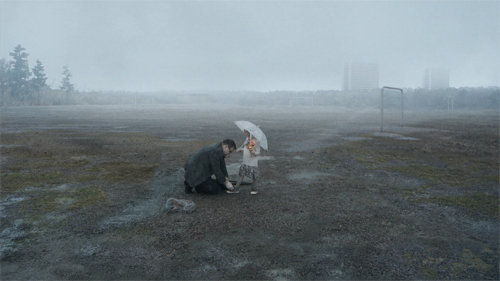
Some are bare-bones situations, as when a young man watches a young woman watering a plant, or when a father ties his little girl’s shoe in a rainstorm. Others unfold a dramatic crisis. A man bursts into tears on a city bus, complaining that he doesn’t know what he wants. A dentist, put off by a patient’s yowls of pain, simply walks out of the consultation and ends up in a bar.

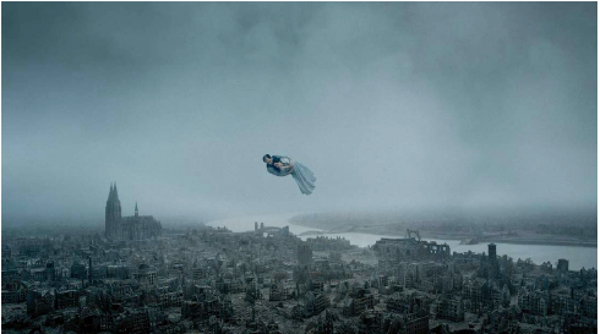
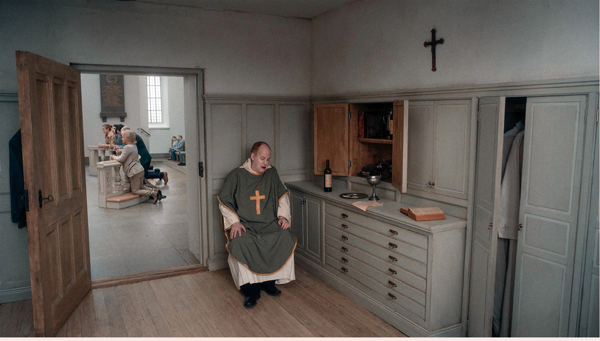
Some shots draw on our knowledge of a broader story, as when Hitler stalks into one chamber of his bunker and his lieutenants, exhausted by the bombardment, sporadically salute him. He hardly seems to notice. A few tableaux present a recurring thread, like minimalist running gags. A man recognizes a schoolmate, but wonders why the man won’t greet him. A priest feels himself losing his faith, gets drunk while celebrating mass, and consults a doctor for advice. And one recurring image shows a woman cradled in a man’s arms floating in the sky–at one point drifting over the ruins of the bombed Cologne of World War II.

What makes Andersson’s cinema so fascinating is his effort to design intricate, gradually unfolding compositions that harbor powerful emotional expression. Dialogue is at a minimum; objects are arranged with the precision of still lifes. His people are often doughy and plodding, with hangdog expressions and complexions like pumice, living in a world dominated by grays and pastel browns. His movies reveal how many shades of beige there can be.

The grandeur of the distant framings accentuate the impotence of the characters. These sad creatures are caught in strict, unsympathetic perspective, all sharp angles and endless vistas. They stand exposed by flat, minimally sculptured lighting. “I avoid shadows,” he explained at the press conference. “I want to make pictures where people can’t hide. A light without mercy.”

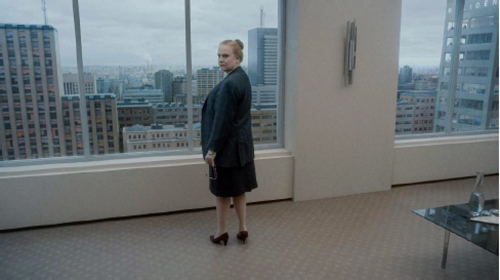
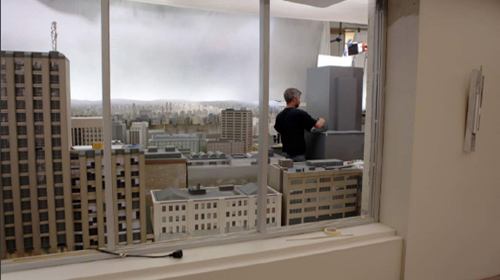
The same mercilessness is seen in the settings, which may look fairly naturalistic but are wholly artificial. Andersson uses miniatures, background painting, and digital effects to create his picture-book landscapes. Streets, cities, train platforms are all the product of years of preparation. Like Tativille in Jacques Tati’s Play Time, Andersson’s sets create a beguilingly realistic version of a wholly fake city.

The sets are calculated to make sense from a single vantage point, as Renaissance paintings are. In a shot like the first one below, moving the camera would reveal the forced-perspective buildings outside.

Some of these landscapes are as eerie as de Chirico’s, but without any of the sensuous shading.

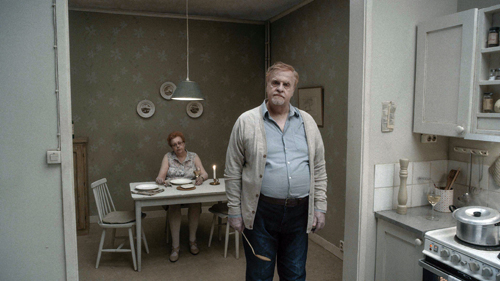
Which means that posture, gesture, and objects near and far have to carry the drama, however anecdotal it may be. The man who thinks his old friend has snubbed him tells us that the friend has a Ph.D. His wife consoles him (after all, they’ve been to Niagara Falls), but he’s still anxious. His puzzled fretfulness is carried by his slumped bearing, his plaintive expression, and his clinging to his slotted spoon. Meanwhile we hear his pasta simmering ever more loudly in the kettle in lower frame right, a light objective correlative to his annoyance.

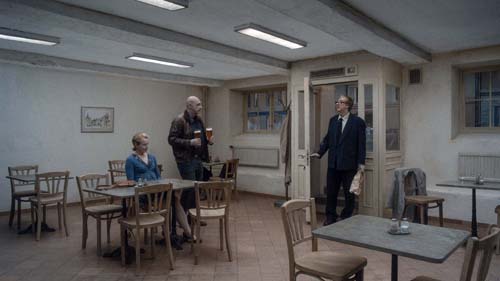
Andersson teases us by letting us imagine how a micro-story might unfold. In a cafe, a woman sits alone, with no drink in front of her. She’s in the classic posture of waiting, A man eats dinner behind her (his cutlery clinks) and an empty table on far right bears the traces of another customer. In comes a large, lumpish fellow brandishing a bouquet. He hesitantly asks for Lisa Larsson. So it’s a rendezvous?

Nope. A bald man enters from frame left bearing two beers.

The lady doesn’t admit to being Ms. Larsson. Maybe she really isn’t, or maybe she found a better date. In any case, the newcomer turns and leaves, a bit sadly. Of course, there’s always the possibility that the absent customer on the right was his date. We, and he, won’t know.

Note, in passing, Andersson’s use of classic staging techniques. Tableau cinema depends on tactics that guide our attention, such as central placement, frontal positioning, and patterns of blocking-and-revealing. By giving the bald man a central position in the format and letting him mask our view of the man eating in the corner, Andersson makes sure we’ll register the confrontation between him and the intruder.

Most of the tableaux are accompanied by a brief voice-over, a woman saying, “I saw…” followed by a single-sentence description of the action. Andersson claims to see her as a bit like Scheherazade, but she has as little commitment to a full story as he does. Her narration provides very little judgment on the scene but does supply a bit of information–often grim, as when we learn that a busker lost his legs in combat.

Indeed, war is a recurring motif in the film, making it bleaker than any of the other Andersson films I recall. Now the minor miseries and absurdities of modern life sit along a continuum of death  and destruction. A sequence of spontaneous dance here, a father’s awkward love for his daughter there–these don’t wholly compensate for a wartime execution or the bombing of Dresden. The gags are fewer now, and Andersson’s fantastical but stubbornly tangible cities have never looked more oppressive. The idea of endlessness stretches in many provocative directions: the infinite vistas of city and sky, the pinpricks of guilt and frustration in everyday life, the obscene endlessness of war. Lucky are those who can in a gentle embrace float above it all.


Andersson’s last film, A Pigeon Sat on a Branch Reflecting on Existence, won the Golden Lion for Best Film in Venice in 2014. Maybe this one will too? It’s one of the best new films I’ve seen here this year. More on the others, in later entries!


Thanks to Paolo Baratta and Alberto Barbera for another fine festival, and to Peter Cowie for his invitation to participate in the College Cinema program. We also appreciate the kind assistance of Michela Lazzarin and Jasna Zoranovich for helping us before and during our stay.

We’ve written bits on Andersson’s films elsewhere in our blog entries. See our entries on tableau staging for lots more on how this stylistic approach works. I discuss the technique as well in On the History of Film Style and Figures Traced in Light: On Cinematic Staging.

About Endlessness (2019).


from Observations on film art https://ift.tt/2ZNYi7C

Venezia 76 - Barn (Beware of children)

In concorso alla settantaseiesima edizione del Festival di Venezia, nella sezione delle Giornate degli Autori Barn (Beware of Children) scuote le coscienze del pubblico, affrontando più tematiche psico-sociali spaziando dalla pedagogia, passando attraverso la famiglia e collegandosi a doppio nodo all'omosessualità.

Il film ripercorre le drammatiche conseguenze di un tragico evento accaduto in un sobborgo della classe media di Oslo. Durante la ricreazione, la tredicenne Lykke, figlia di un importante membro del partito laburista, ferisce gravemente il suo compagno di classe Jamie, figlio a sua volta di un politico di alto profilo di destra. Quando Jamie muore in ospedale, le versioni contraddittorie di ciò che è realmente accaduto, rischiano di peggiorare una situazione già complessa e traumatica.

Il film norvegese, diretto Johan Haugerud è un vero e proprio trattato psicodidattico dei complicatissimi rapporti che possono intercorrere tra i vari componenti di una famiglia contemporanea della società occidentale, in questo caso di una scandinava, per antonomasia tra le più evolute del panorama europeo.
Barn sembra dimostrare che anche l'evoluzione più ammirevole, spesso possa essere contrastata dagli stereotipi sociali, tra cui quello di una mancanza di un equilibrio educativo all'interno di famiglie troppo “libere” e appartenenti a un sistema vicino a quello steineriano, questo è ciò che emergere sopratutto attraverso le reazioni dei personaggi del film, che tra loro sono tutti collegati da un fil rouge.
La protagonista Lykke, è infatti l'allieva prediletta di Anders, l' insegnante di finlandese di cui Jamie era forse innamorato, Anders a sua volta è il fratello di Liv, preside della scuola e responsabile dell'accaduto, che la porta a vivere una situazione di profonda crisi.
A complicare il tutto si aggiunge il fatto che Liv sia anche l'amante segreta del padre di Jamie, a causa delle opposte vedute politiche, che avrebbero creato scompensi nella famiglia progressista della donna.
Dopo il terribile incidente tutto viene svelato, non solo il rapporto tra Liv e il suo compagno destrorso, ma anche i più sottili aspetti pscicologici di personaggi che somigliano in maniera impressionante a quelli più teatrali del vicino svedese Strinberg, in versione femminile, non più misogina: potremmo definirlo un adattamento della forza femminile nella modernità nordica.
Nel film, come in molta letteratura scandinava, emerge il ruolo di forza e centralità della donna accompagnato da un'attuale visione dell'amore e dei rapporti, che oggi proprio per la loro libertà risultano essere ancora più complessi e profondi.
Oltre alla tematica educativa e al senso di colpa di una mancanza genitoriale, inverata attraverso i personaggi dei genitori della bambina, nel film sono affrontati anche aspetti molto peculiari di coppie non troppo convenzionali: la coppia gay e la coppia della famiglia allargata.
Vince su tutto naturalmente il sentimento, per ciò che appare in un film che potremmo definire un affresco di naturalismo scandinavo, attraverso una fotografia molto accesa e la direzione di attori molto preparati su una sceneggiatura non proprio semplicissima, visti i numerosi contenuti psicologici che la riguardano.
Nonostante la lunghezza eccessiva del film, che in alcuni momenti sembrerebbe più una fiction televisiva, Barn si lascia vedere con gradevolezza grazie a dei contenuti umani di tutto rispetto, e di grande attualità in una società che si è evoluta velocissima rispetto alle intricate e spinose questioni relazionali e sentimentali del mondo contemporaneo.

(Barn-Beware of children) Regia: Dag Johan Haugerud; sceneggiatura: Dag Johan Haugerud; fotografia: Øystein Mamen; montaggio: Jens Christian Fodstad; musica: Arnaud Fleurent-Didier, Peder Kjellsby; interpreti: Henriette Steenstrup (Liv), Jan Gunnar Röise (Anders), Thorbjörn Harr (Per Erik Lundemo), Brynjar Bandlien (Jan), Andrea Bræin Hovig (Eva, madre di Lykke), Hans Olav Brenner (Sigurd, padre di Lykke), Anne Marit Jacobsen (Torunn), Ella Øverbye (Lykke); produzione: Motlys A/S; origine: Norvegia, Svezia, 2019; durata: 157'


from Close-Up.it - storie della visione https://ift.tt/30VxaVZ

Bad Boys for Life: il primo scatenato trailer del ritorno di Will Smith e Martin Lawrence

25 anni dopo torna la coppia di detective di Miami nel film diretto da Adil El Arbi e Bilall Fallah.

from ComingSoon.it - Le notizie sui film e le star https://ift.tt/2MR5zBL

via Cinema Studi - Lo studio del cinema è sul web