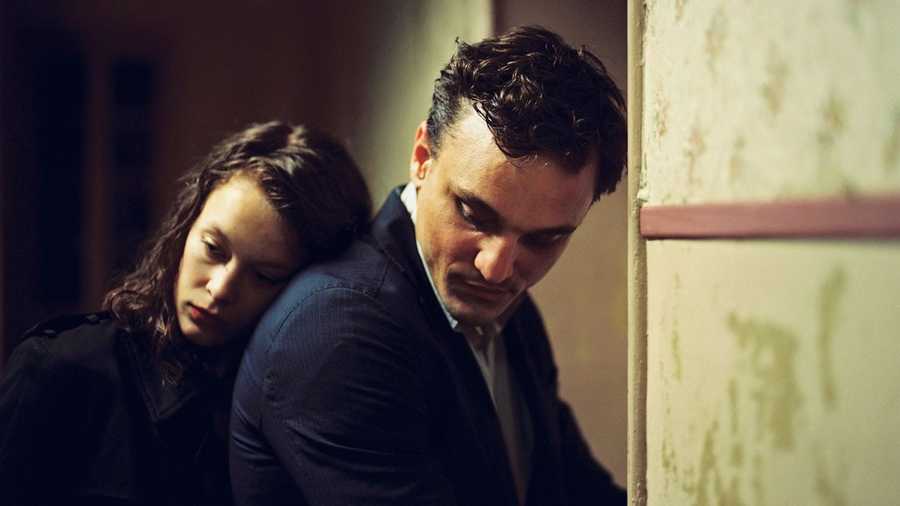
Christian Petzold seems to realize that viewers are going to feel as if they’ll need a few moments to get their bearings in the world of Transit. In one swift and brilliant stroke, he denies us the luxury. Georg (Franz Rogowski) enters a café from the sun-seared streets of present-day Paris, meets up with a contact, and the two of them plunge headlong into a hushed and urgent discussion of transit papers, visas, and passports, sounding for all the world like Rick, Ilsa, and Victor in Casablanca (1942).
Georg, we learn, as we strain to keep up, is a German refugee who’s spent time in a camp run by the fascists who are now on the verge of taking the French capital. His mission, should he choose to accept it—he does—is to get a collection of documents guaranteeing safe passage to a famous author, Weidel, in Marseille. Transit is based on the eponymous novel by Anna Seghers, written in 1942, when the proverbial lights were going out all over Europe. But as the graffiti on the walls, the cars, the clothes, and every other possible indicator blare as loudly as the police sirens sweeping up and down the Parisian streets, the events of this movie are happening right now.
The conceit is daring, not least because, as a statement, it’s almost too obvious. But from that first handoff in the café, through a chase on foot, followed by a tense train journey, Petzold leaves us no time to object. By the time Georg arrives in Marseille, we’ve learned—and learned to accept—the rules and parameters of this nightmare. And once these suspenseful sequences have begun to ratchet down, Petzold shifts modes—to melodrama. With one fellow resister arrested back in Paris, and another having died en route to Marseille, Georg sets about saving his own skin. He takes on an identity that’s going to present an emotionally devastating dilemma when he falls for young Marie (Paula Beer).
Like Casablanca’s Casablanca, Transit’s Marseille is a limbo in which the clock is ticking on every reprieve from fear, every small pleasure. Word spreads that the fascists have taken Avignon. It won’t be long now. And as in Rick's Café Américain, we see the same set of characters weaving in and out of the narrative, all plotting to make their escape, and nearly every one of them with a story or two to tell of how he or she practically had one foot on the boat when something yanked them back into the port city. Baked in persistent, almost oppressive sunlight, Marseille doesn’t look haunted, and yet, particularly in a fleeting tease toward the end, Petzold suggests here and there that the reality of Transit may be as ephemeral as his command of cinematic storytelling remains, as ever, masterful.
The café in Seoul in which much of Hong Sangsoo’s Grass takes place isn’t, in the strictest sense, haunted, but death, desperation, and anger weigh heavily in this black and white, sixty-six-minute feature, Hong’s twenty-second. Grass opens with a conversation between a woman and a man that takes a deep dive when she accuses him of refusing to recognize his responsibility for the suicide of one of their friends. Moments later, she’s taken on some of that burden herself as well.
Eventually we become aware of the presence of Areum (Kim Minhee) at a corner table, making little effort to disguise the fact that she’s eavesdropping as she taps away on her laptop. We hear her thoughts in voiceover narration, suggesting that she may be conjuring these café visitors in her imagination and writing their dialogue on virtual pages. Another table, another accusation of causing another suicide. But then Areum up and leaves with her brother and fiancé to wander to another café where she berates them for rushing into marriage. Back at the first café, she—reluctantly at first—joins a table to mingle with drinkers who, again, may or may not be her own creations.
Grass raises countless engaging questions (see below). It feels as if it takes place over the course of a single afternoon and evening, but out in front of the café, a pot with young sprouts is shown in a later shot to be flourishing with full-grown leaves. I’ll freely admit to being both stumped and captivated by this latest collaboration between Hong and Kim, a project that seems to be growing darker with each new chapter.
One of the highlights of this year’s Berlinale so far is the Forum’s presentation of a newly restored 35 mm print (from the original 16 mm) of James Benning’s 11 x 14 (1977). A certain degree of mathematical thinking has gone into its construction, and you can read about what Benning was up to back then at Light Industry, which presented 11 x 14 in 2012.
None of that was on my mind as I luxuriated in the vibrant grain. Those, like me, who’ve been familiar only with Benning’s later work may be surprised by how entertaining and, at times, even funny 11 x 14 is. It can be viewed as a series of one-shot vignettes with recurring characters and revisited locations, each throwing a new perspective on the ones that preceded it. Dialogue is rare, muffled, and all but indecipherable, but that doesn’t mean 11 x 14 isn’t a film to listen to as well as admire for its framing and composition. There’s the roar of an approaching airliner, the insect ambience of an open field, the whooshing of cars (this would be a fine addition to a program of road movies), and, at one point, Bob Dylan’s “Black Diamond Bay” (1976, 7’31”), played in full in a “scene” that shows us, in a lower corner, the vinyl revolving. More scenes come and go before a surprise encore of “Black Diamond Bay,” again in full, and it’s up to you to decide whether the accompanying visual is intended as a punchline.
WHAT OTHERS ARE SAYING
Transit
For Variety’s Guy Lodge, Petzold’s “extraordinary anti-historical experiment . . . registers as his most conceptually daring film to date. . . . Transit invites viewers to trace their own speculative connections between Seghers’s narrative and the contemporary rise in neo-Nazism and anti-refugee sentiment, all while its surtext remains achingly moving.”
“These characters never become more than ciphers for some abstract horror, their humanity only bubbling to the surface when the narrator (the local bartender, of course) begins to describe his memory of them,” writes IndieWire’s David Ehrlich. “It’s only during these brief moments that we can fully appreciate Georg’s disarray or the contours of Marie’s crisis.”
“Intense and mesmerizing German up-and-comer Rogowski is perfectly cast as Georg, who’s enigmatic and fascinating in equal measure,” writes Boyd van Hoeij in the Hollywood Reporter. “The awesomely named Lilien Batman plays a small but crucial role as soccer-fanatic child who’s befriended by Georg in the film's most beguiling moments. Cinematographer Hans Fromm, production designer K.D. Gruber, both Petzold regulars, and costume designer Katharina Ost together create a world that’s contemporary but with an edge of timeless.”
More from Demetrios Matheou in Screen.
Grass
“Kim Minhee’s eavesdropper . . . realizes multiple times . . . that many of the people she’s eyeing are in fact professional actors, calling into doubt, as is so deliciously common in this director’s films, just what it is we’re seeing,” writes Notebook editor Daniel Kasman. “Is this a dream? Imagination? Fantasy? A wake? A brief but truly unexpected use of lens focus and shadowplay, for this usually formally minimalist director, ripples with such uncertainty. Whatever state of existence Grass is taking place on, one thing is for certain: It’s Hongian playfulness of surprisingly soulful intrigue.”
“And we can further wonder if this Areum is the same Areum, also an aspiring writer played by Kim Minhee, who appeared in Hong’s 2017 The Day After,” notes Jessica Kiang in Variety. “If so, would that make Grass a sequel or a prequel in the Hong Cinematic Universe?”
More from Deborah Young (Hollywood Reporter) and Sarah Ward (Screen).
11 x 14
The Forum’s put together a fine collection of notes and reviews.
For news and items of interest throughout the day, every day, follow @CriterionDaily.
from The Criterion Current http://ift.tt/2C4WRdU

Nessun commento:
Posta un commento