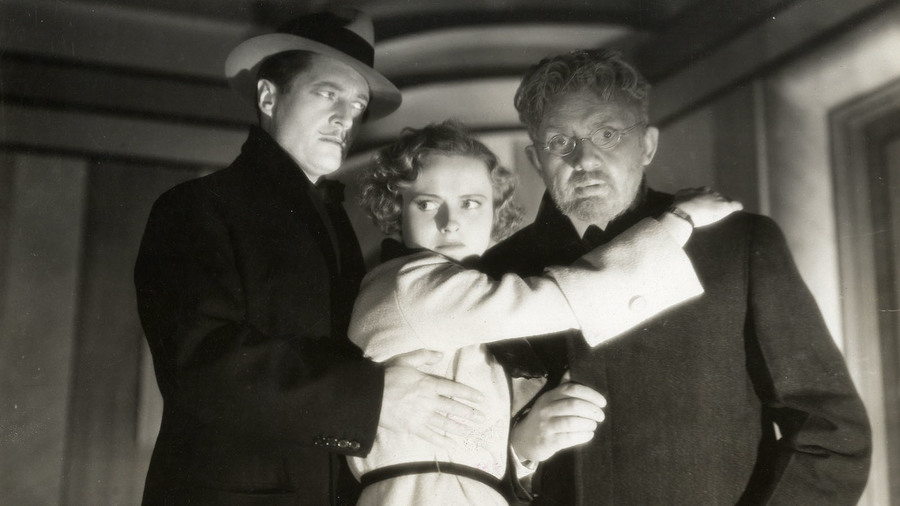
To Save and Project: The 15th MoMA International Festival of Film Preservation opens tonight with William K. Howard’s Transatlantic (1931; image above), “a pre-Code comedy firmly set during the golden age of ocean travel,” as Caroline Golum notes at Screen Slate. “Beyond the sumptuous interiors of the ship itself (art director Gordon Wiles snagged an Academy Award for his work), Transatlantic abounds in elegance . . . Howard honors this stately steel leviathan with artistry to match: from swanning dolly shots, weaving through first-and-second class passengers alike, to coy glances at smart chapeaux and handsome pups.”
When it screened at Il Cinema Ritrovato last summer, the festival noted: “If Transatlantic has not received the attention it merits, it is largely because of its shaky state of preservation: no complete copy of the American release version has survived. This new restoration from the Museum of Modern Art matches the complete English audio track to picture elements derived from the French, Italian and Spanish export versions, yielding a full sense of the film for the first time in eighty years.”
The festival also offered an appreciation of Howard’s work by To Save and Project programmer Dave Kehr, who notes that “cinematographer James Wong Howe, Howard’s collaborator on the brilliant deep focus effects of the 1931 Transatlantic, described him as the most creative filmmaker he had ever worked with. . . . The ocean liner of Transatlantic is perhaps the most intricately realized of Howard’s narrative spaces, a maze of staterooms and ladders.”
For David Cairns, Howard “a sort of ‘Grand Hotel at sea meets The Saint’ into something genuinely, excessively cinematic. We get to enjoy a young Myrna Loy, a heavily disguised Jean Hersholt, and a couple of obscure beauties—Lois Moran in the boring nice girl role and Greta Nissen as the much more exciting bad girl, dancing frenetically in a top hat. The film seems like a B-movie (perhaps a Saint one) made on a super-A budget, and the new restoration is gorgeous, all art deco white and sweep and dash.”
As J. Hoberman notes, writing for the New York Review of Books, this year’s edition of To Save and Project “has something for everyone: the silent, Douglas Fairbanks version of The Three Musketeers (on 35 mm), Ida Lupino’s 1950 B-movie Outrage (a film about rape in which, thanks to the production code, the word is never used), William K. Howard’s 1932 Sherlock Holmes (starring Clive Brook), programs devoted to Cinerama and the work of the Canadian expeditionary filmmaker who called herself Aloha Wanderwell, and, showing in one marathon screening, R. W. Fassbinder’s eight-hour 1972 mini-series Eight Hours Don’t Make a Day.”
Critics Round Up has an entry on Eight Hours, pointing us to pieces by Aliza Ma and Nick Pinkerton in Film Comment as well as a Film Comment Podcast devoted to the series (55’10”).
CRU also has roundups on Chantal Akerman’s Les rendez-vous d’Anna (The Meetings of Anna, 1978), screening Monday and Thursday, and Fritz Lang’s The Woman in the Window (1944), screening January 26 and 27.
Back to David Cairns and to William K. Howard. Sherlock Holmes “sports a fine Watson in Reginald Owen, who anticipates Nigel Bruce’s interp (‘By Jove, Holmes, it’s a positive ambuscade!’) and a transcendent Moriarty in Ernest Torrence . . . The stagey talking scenes are one thing, but Howard shows his creativity between scenes, as with a dazzling montage introducing a funfair straight out of Lynchland.”
The festival’s on through February 1, and as more reviews appear, we’ll be making note of them here.
For news and items of interest throughout the day, every day, follow @CriterionDaily.
from The Criterion Current http://ift.tt/2DnFYfp

Nessun commento:
Posta un commento