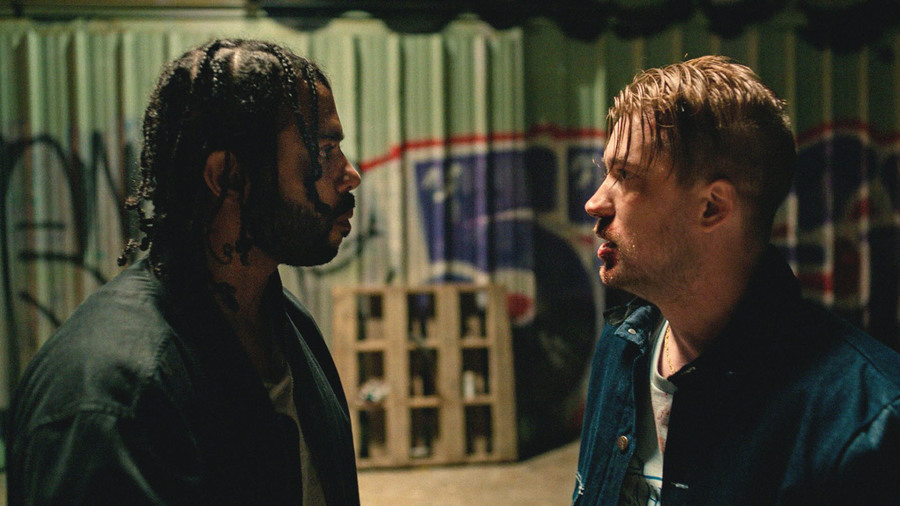
“With issues of women’s equality, sexual misconduct, and political turmoil heavy on the movie world’s mind, Sundance Film Festival Director John Cooper said he wanted to start the 2018 edition with a movie that’s ‘fun to the point of sassy,’” notes Sean P. Means in the Salt Lake Tribune. “Cooper delivered that to a receptive Park City audience Thursday with the comedy-drama Blindspotting, a raucous, rap-filled and often revealing story of male friendship on the rapidly gentrifying streets of Oakland, Calif.”
“Bluntly dissecting America’s racial and economic strife with the urgency of young storytellers hungry to have their voices heard,” writes Screen’s Tim Grierson, “this upstart portrait of two lifelong friends doesn’t pretend to have answers for the seemingly intractable social ills it explores—nor does it deny that its main characters are, in some ways, part of the problem. But as led by Daveed Diggs’s impassioned, tormented performance, Blindspotting is hard to shake, despite its on-the-nose plot points and melodramatic flourishes.”
For Variety’s Peter Debruge, this is “the most exciting cinematic take on contemporary race relations since Do the Right Thing nearly thirty years ago. . . . Diggs is already something of a known commodity, having earned a Tony award for his spitfire double-duty as both Thomas Jefferson and Marquis de Lafayette in Hamilton. But Blindspotting was [Rafael] Casal’s project to begin with, and he does the fiercest rhyming in a film that isn’t quite a musical, but transitions ever so naturally into sung-spoken verse whenever the characters have something truly passionate to impart. . . . Here, the charismatic real-life friends play black-and-white besties who work for a moving company that brings them into contact with the city’s nouveau riche. And though the two have clearly got one another’s backs, there’s undeniable tension between Collin (Diggs) and Miles (Casal) that’s bound to erupt before the movie ends.”
“Casal, a hot-blooded white man who behaves like a crude inner-city caricature, serves as a blunt wild card to animate Collin’s broader conundrum,” explains IndieWire’s Eric Kohn. “He’s a black guy with dreads who gets pigeonholed in the worst possible way, even though his best friend acts a whole lot worse. This dynamic simmers in their scenes together, until it finally bursts in a climactic showdown that’s at once inevitable and terrifying for the authentic rage Diggs brings to the scene. Unfortunately, Blindspotting is continually marred by the fancy trickery of a filmmaker incapable of reining in the material, as split screens, an exuberant flashback, and flashy transitions constantly get in the way of letting the stronger exchanges stand out.”
At TheWrap, Alonso Duralde finds that Blindspotting “puts far more on its plate than it knows how to handle. It’s a story about gentrification, police violence, the rules of being a white person growing up surrounded by black culture, the criminal justice system, institutionalized racism, guns in the home and the semiotics of hair, jolting with jarring artlessness between witty comedy and intense drama.”
Blindspotting “betrays instincts both realistic and fantastical, insightful and banal,” writes the Hollywood Reporter’s Todd McCarthy. “The women in the men’s orbit unfortunately remain mostly on the sidelines. The rap is compulsive, while technically, the film is rough and ready.”
“And now after all that, can you believe that Blindspotting is actually pretty funny?” asks Mike Ryan at Uproxx.
For news and items of interest throughout the day, every day, follow @CriterionDaily.
from The Criterion Current http://ift.tt/2Dg8xar

Nessun commento:
Posta un commento